Adam Smith Theory of value
Adam Smith started his discussion of value by distinguishing between value in use and value in exchange. The first refers to the utility of the commodity and the second the power of purchasing other goods. This he explained with the “diamond-water paradox”. The commodities like water possessing greatest value-in-use have little value-in-exchange.
On the other hand, the commodities like diamond having little value-in-use have the greatest value-in-exchange. Even though Smith made a distinction between value in use and value in exchange, he was concerned only with the true measure of the exchangeable value.
Regarding the determination of value, Smith explained through two theories of value, namely, labour theory of value and cost of production theory of value. Smith believed that labour was the real source of value. The value of a thing depended upon the amount of labour spent for its production.
According to him, the real price of everything was “the toil and trouble of acquiring it”. This was the essence of his Labour Theory of Value. Thus the theory that labour is the cause of value was first formulated by the Father of Political Economy. It is the same theory which was used later on by Karl Marx to attack capitalism.
But in his cost of production theory of value, Smith gave a contradictory view. He said the value of a commodity was governed by its cost of production. This consisted of payments made to land, labour and capital. Smith could not make a clear choice between these two theories.
It must be noted that Smith not only discussed the different elements of the price of a commodity but also natural price and market price. He says that in an early primitive society where capital accumulation had not started and land was not appropriated, labour alone was the sole determinant and measure of value. Then he turns to the actual world where more than one factor of production exists, and the production of a commodity is the result of the co-operative efforts of labour, land and capital. In such a situation, the price of a commodity is the sum of the rewards paid to labour, land and capital.
Then Adam Smith proceeds to the treatment of natural and market prices. In each society, there exists an average rate of interest, wages, profit and rent, which Adam Smith calls, “the natural rates”, corresponding to this is the natural price. It is the price which covers the natural rates of profits, wages and rent. Thus the concept of natural price is essentially the cost of production theory of value.
Contrary to this is the market price. The market price is the actual price prevailing in the market and is determined by the forces of demand and supply. The competitive mechanism of the market ensures the tendency towards the equilibrium or natural price in the long run.
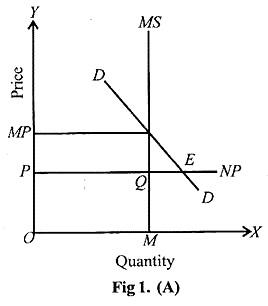
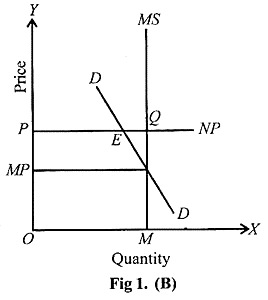
If the market price is higher than the natural price, the supply will increase and will bring the market price down to its natural price. Similarly, if the market price is less than the natural price, the supply will increase and push the market price down to the natural price.
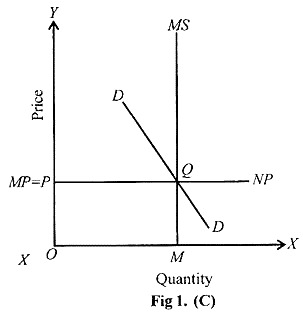
The following figures show this:
In figure 1. (A) demand is greater than the market supply (PE > PQ). So market price is above the natural price (MP > P). In part (B) demand is less than the market supply (PE < PQ) market price is less than the natural price (MP < P). In part (C) demand is equal to supply. So market price and natural price are equal NP = P.
Comments
Post a Comment